
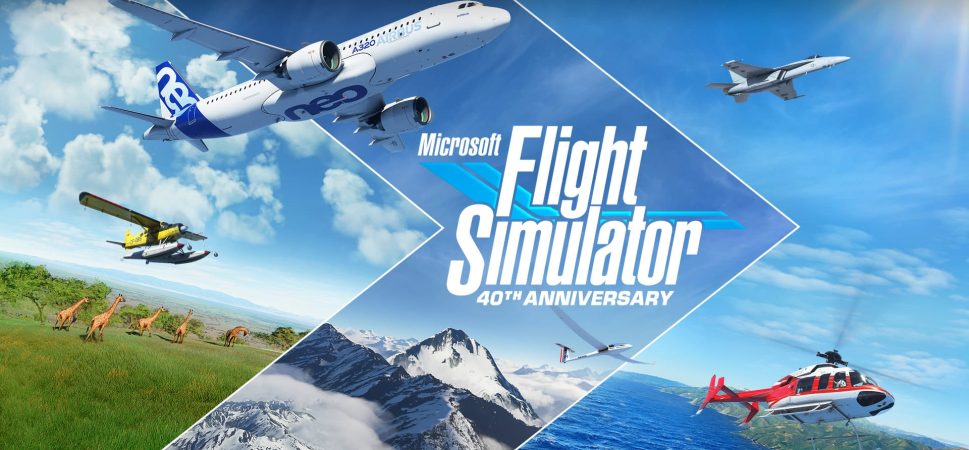
Microsoft Flight Simulator is a series of flight simulator programs for MS-DOS, Classic Mac OS and Microsoft Windows operating systems. It was an early product in the Microsoft application portfolio and differed significantly from Microsoft’s other software, which was largely business-oriented. As of November 2022, Microsoft Flight Simulator is the longest-running software product line for Microsoft, predating Windows by three years.[2] Microsoft Flight Simulator is one of the longest-running PC video game series of all time.[3][4]
Bruce Artwick began the development of Flight Simulator in 1977. His company, Sublogic, initially distributed it for various personal computers.[4] In 1981, Artwick was approached by Microsoft’s Alan M. Boyd who was interested in creating a “definitive game” that would graphically demonstrate the difference between older 8-bit computers, such as the Apple II, and the new 16-bit computers, such as the IBM PC, still in development. In 1982, Artwick’s company licensed a version of Flight Simulator for the IBM PC to Microsoft, which marketed it as Microsoft Flight Simulator 1.00.
In 2009, Microsoft closed down Aces Game Studio, which was the department responsible for creating and maintaining the Flight Simulator series. In 2014, Dovetail Games were granted the rights by Microsoft to port the Gold Edition of Microsoft’s Flight Simulator X to Steam and publish Flight Simulator X: Steam Edition.
Microsoft announced a new installment at E3 in 2019, simply titled Microsoft Flight Simulator, to be released initially on PC and ported over to the Xbox Series X at a later date. On July 12, 2020, Microsoft opened up preorders and announced that Microsoft Flight Simulator for PC will be available on August 18, 2020.[5] The company announced three different versions of the title – standard, deluxe, and premium deluxe, each providing an incremental set of gameplay features, including airports, and airplanes to choose from.[6] The Xbox edition was released on July 27, 2021.[7]
History
Microsoft Flight Simulator began as a set of articles written by Bruce Artwick in 1976 about a 3D computer graphics program. When the magazine editor said that subscribers wanted to buy the program, Artwick set to work to create it and incorporated a company called Sublogic Corporation in 1977. The company began selling flight simulators for several computer platforms, including the 8080, Altair 8800, and IMSAI 8080. In 1979 Sublogic released FS1 Flight Simulator for the Apple II. In 1980, Sublogic released a version for the TRS-80, and in 1982 they licensed an IBM PC version with CGA graphics to Microsoft, which was released as Microsoft Flight Simulator 1.00 on a self-booting disk. In the early days of less-than-100% IBM PC compatible systems, Flight Simulator and Lotus 1-2-3 were used as unofficial compatibility test software for new PC clone models.[8]
Sublogic continued to develop for other platforms and ported Flight Simulator II to the Apple II in 1983; the Commodore 64, MSX, and Atari 800 in 1984; and to the Amiga and Atari ST in 1986. Meanwhile, Bruce Artwick left Sublogic and founded The Bruce Artwick Organization to continue his work on subsequent Microsoft releases, beginning with Microsoft Flight Simulator 3.0 in 1988. Microsoft Flight Simulator reached commercial maturity with version 3.1, and went on to encompass the use of 3D graphics and graphic hardware acceleration.
Microsoft continued to produce newer versions of the flight simulation software, adding features, such as new aircraft types and augmented scenery. The 2000 and 2002 versions were available in “Standard” and “Professional” editions, where the latter included more aircraft, tools and scenery options. The 2004 release (version 9) marked the celebration of one hundred years of powered flight and had only one edition. Flight Simulator X, released in 2006, returned to dual versions with a “Standard” and a “Deluxe” edition.
The flying area encompasses planet Earth with varying degrees of detail and includes over 24,000 airports. There is an ever-growing list of scenery representing major landmarks and popular cities. Landscape details become sparse as gameplay moves away from population centers within the flight simulator, particularly outside the United States, although a variety of websites offer scenery add-ons to remedy this.
The three latest versions incorporate sophisticated weather simulation, along with the ability to download real-world weather data (first available with Flight Simulator 2000). Additional features in these newer versions include air traffic environments with interactive air traffic control functions, new aircraft models from the historical Douglas DC-3 to the modern Boeing 777, interactive lessons, challenges, and aircraft checklists. The two latest versions of Microsoft Flight Simulator have a “kiosk mode”, which allows the application to be run in electronic kiosks located in public places like shopping malls. Microsoft Flight Simulator has a wide selection of upgrades and add-ons, both free and commercial, official and fan-made.
Microsoft Flight Simulator X
Microsoft Flight Simulator X is the third most recent major release of Microsoft Flight Simulator, and the last one developed by Aces Game Studio. It includes a graphics engine upgrade and compatibility with preview DirectX 10 and Windows Vista. It was released on October 17, 2006, in North America. There are two versions of the game, both on two DVDs. The “Deluxe” edition contains the new Garmin G1000 integrated flight instrument system in three cockpits, additional aircraft, and missions; Tower Control capability in multiplayer mode; higher detail scenery for cities and airports; and a Software Development Kit (SDK) for development. The main improvements are graphical.
Microsoft has also released a Flight Simulator X demo, which contains three aircraft, two airports, and two missions. It is compatible with Windows XP SP2 and Windows Vista.
Closure of the Aces Game Studio
On January 22, 2009, it was reported that the development team was heavily affected by Microsoft’s program of job cuts, with indications that the entire Microsoft Flight Simulator team had been laid off.[9][10] Microsoft confirmed the closure of the Aces Game Studio on January 26, 2009, in a post on the official FSInsider Web site.[11] stating “This difficult decision was made to align Microsoft’s resources with our strategic priorities. Microsoft Flight Simulator X will remain available at retail stores and Web retailers, the Flight Sim community will continue to learn from and encourage one another, and we remain committed to the Flight Simulator franchise for the long term.”
According to former Aces employee Phil Taylor, the shutdown was not due to sales performance of FSX, but due to management problems and delays in project delivery, combined with increased demand for staff.[12] Speculation in the mainstream and gaming media was that future versions could be released as an Internet-based version, or on Microsoft’s Xbox platform.[13]
In October 2009, two (out of over fifty) former members of the Aces Game Studio formed a new game studio called the Cascade Game Foundry[14] for the development of simulation games.[15][16]
Third-party developer agreement
Lockheed Martin Prepar3D
In late 2007, Aces Game Studio announced Microsoft ESP (Enterprise Simulation Platform), a development platform for companies that want to create products that use the technology in Flight Simulator. Following the closure of the Aces Game Studio in January 2009, Lockheed Martin announced in late 2009 that they had negotiated with Microsoft a licensing agreement to purchase the intellectual property (including source code) for the Microsoft ESP product. It is the commercial-use version of Flight Simulator X SP2. On May 17, 2010,[17] Lockheed announced that the new product based upon the ESP source code would be called Prepar3D (P3D). Lockheed hired members of the original Aces Game Studio team to continue development of the product.
In November 2010, Lockheed Martin debuted Prepar3D version 1.[18] Version 1.1 was released in April 2011, with a retail license cost of US$499.[19] A developer license is also available for a monthly fee of US$9.95. In March 2012, along with the release of version 1.3, the pricing strategy was revised. The Professional edition is now available for US$199, with an Academic License available for US$59.95.
Often touted as ‘FSX on steroids’, P3D has so far had 5 versions, with the latest launched on April 14, 2020.[20] Version 5 features 41 aircraft and over 23000 airports. Before that, version 2, 3 and 4 saw releases in 2013, 2015, and 2017 respectively.
Due to the changes in elevation between version 4 and version 5, many developers charged for upgrades to make their airport sceneries compatible with the new elevation.[21] This elevation issue, in turn, created new developers to pop up to create “compatibility files” for older version 4 airports to work on version 5. Companies such as iniBuilds and Scandinavian Mountains lead the development of compatibility files.[22][23]
Dovetail Games and Microsoft Flight Simulator X: Steam Edition
On July 9, 2014, Dovetail Games announced that Microsoft had granted them rights to develop the next Flight Simulator in the series. Dovetail Games also announced the release of Flight Simulator X: Gold Edition on Steam for late 2014, titled Microsoft Flight Simulator X: Steam Edition. It was released on December 18, 2014. It is a re-release and includes content that was provided with the original FSX: Gold Edition which includes FSX: Deluxe Edition, the Acceleration expansion pack, and both official Service Packs and repackages them in one bundle and a single installation. The Steam Edition includes “all standard Steam functionality”, including an overhaul of the multiplayer support to go through Steam rather than the now-defunct GameSpy,[24] improved stability on Windows 7 and 8, and features minor performance tweaks including a complete recompile using VS2013.[25]
Additionally, Dovetail Games has worked with existing developers and publishers to distribute their content on Steam as DLC. Currently, there are over 100 add-ons for FSX: Steam Edition[26] from over 35 developers available on the Steam store including Aerosoft, Captain Sim, Orbx Simulation Systems, Real Environment Xtreme (REX), Carenado, Virtavia, and others.
Flight Sim World
In May 2017, Dovetail Games announced Flight Sim World, based on the codebase of Flight Simulator X, and released later that month.[27] Only a year later, on April 23, 2018, Dovetail announced end of development of Flight Sim World and the end of sales effective May 15, 2018.[28]
Microsoft Flight
Microsoft released a new flight simulator titled Microsoft Flight in February 2012. Developed by The Coalition (as Microsoft Game Studios Vancouver), it was not part of the Microsoft Flight Simulator series, but instead was designed to replace it and aimed at drawing new users into flight gaming. While claiming to be simpler to use for inexperienced users, it is incompatible with Flight Simulator and does not allow the use of existing Flight Simulator add-ons (including aircraft, objects, and photographic scenery).
The game was “pay to play“, as only the single island of Hawai’i and one aircraft was available without buying downloadable content. On July 26, 2012, Microsoft cancelled further development of Flight.[29]
Microsoft Flight Simulator (2020)
On June 9, 2019, as part of their E3 conference announcements Microsoft revealed that they would be bringing back the Flight Simulator series with an updated release, simply titled Microsoft Flight Simulator. On the same day, Microsoft launched a new website for the title and posted a teaser video on their Xbox YouTube channel.[30] The new version features tight integration of ground satellite data and Microsoft’s own Azure AI into the simulator’s engine to generate near-photorealistic graphics. Asobo Studio is the lead developer.[31]
The game is Microsoft’s first simulator since Microsoft Flight in 2012.[32] In addition to the PC release it was also released for the Xbox Series X and Series S, making it the first entry in the Microsoft Flight Simulator series to be released for a gaming console. The Windows PC version of the simulator was released on August 18, 2020.[33] Microsoft Flight Simulator launched for Xbox Series X and Series S on July 27, 2021.
Microsoft Flight Simulator 2024
On June 11, 2023, during the Xbox Games Showcase Microsoft revealed a trailer for Microsoft Flight Simulator 2024,[34] which was captioned “the next generation of the legendary franchise”.
Add-ons, customization, and community involvement
The long history and consistent sales of Flight Simulator has encouraged a very large body of add-on packages to be developed as both commercial and volunteer ventures. A formal software development kit and other tools for the simulator exist to further facilitate third-party efforts, and some third parties have also learned to ‘tweak’ the simulator in various ways by trial and error. As for number of add-ons, tweaks, and modifications Flight Simulator can accommodate solely depends on the user’s hardware setup. The number is not limited by the simulator, and when multiple computers are linked together with multiple monitors and third-party software and controls, Flight Simulator enthusiasts can build their own realistic home cockpits.