
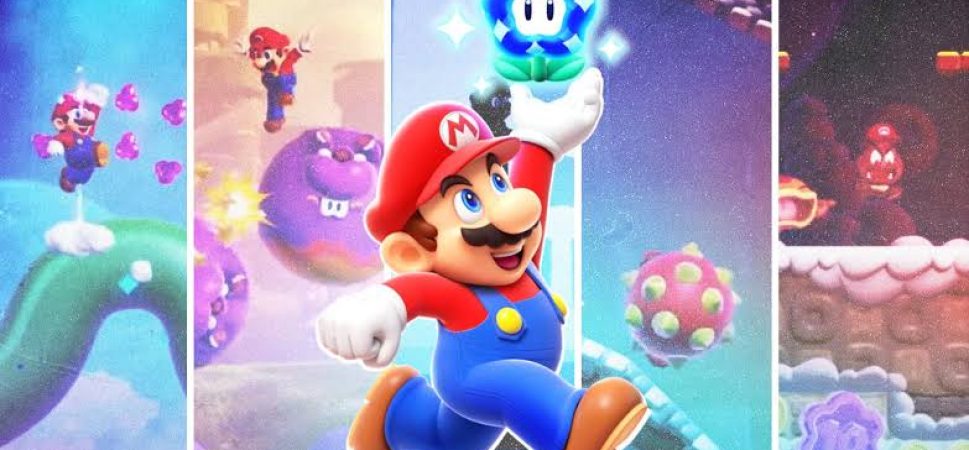
For over a decade, Nintendo’s traditional side-scrolling Mario games felt like they were stuck on autopilot. Don’t get me wrong—the New Super Mario Bros. series offered tight controls and solid multiplayer fun, but it lacked a certain magic. It felt safe, sanitized, and predictable.
Then came Super Mario Bros. Wonder.
Released as a flagship title for the Nintendo Switch (and recently expanded with a dedicated edition for Nintendo’s latest hardware), Super Mario Bros. Wonder didn’t just refresh the 2D platforming genre—it completely tore up the rulebook. Selling over 17 million copies globally, it has cemented itself as the fastest-selling Mario title in history.
Here is a deep dive into how Nintendo recaptured lightning in a bottle, and why Wonder is a mandatory study in modern game design for tech and gaming enthusiasts alike.
1. The Power of “Unpredictability” (The Wonder Flower Effect)
The core philosophy behind older 2D Mario games was consistency. You knew what a green pipe did, you knew how a Goomba moved, and you knew exactly what happened when you grabbed a Fire Flower.
Wonder changes everything by introducing the Wonder Flower.
Touching a Wonder Flower triggers a localized reality shift that alters the fundamental mechanics of the level. Suddenly, the terrain might start tilting, pipes might come alive and crawl like inchworms, the perspective might shift to a top-down camera, or Mario might float away into outer space.
The Design Takeaway: By introducing a mechanic where the player literally cannot predict what happens next, Nintendo successfully eliminated “player fatigue.” It replaces the standard checklist loop of traditional platformers with genuine, laugh-out-loud curiosity.
2. Rejecting the Sandbox: Why 2D Constraints Still Win
In an era dominated by massive, open-world tech marvels like The Legend of Zelda: Tears of the Kingdom or Grand Theft Auto, it’s easy to assume that linear 2D gaming is a relic of the past.
Super Mario Bros. Wonder proves that limitations breed pure creativity. By forcing gameplay onto a fixed horizontal plane, the designers had to maximize the impact of every single screen.
Bold New Power-Ups
Instead of recycling the same old suits, Wonder introduces highly creative power-ups that completely alter how you interact with the environment:
-
Elephant Fruit: Transforms characters into an elephant, allowing them to swing their trunks to smash blocks, reflect projectiles, and store water to grow hidden plants.
-
Bubble Flower: Lets you shoot floating bubbles that trap enemies or act as temporary, custom-placed jumping platforms.
-
Drill Mushroom: Allows you to burrow into the ground or the ceiling, bypassing obstacles entirely and opening up clever vertical exploration.
3. The RPG-Lite Upgrade: The Badge System
One of the most significant mechanical shifts in Wonder is the introduction of the Badge System. Before starting a level, players can equip a single badge that grants a passive perk or an active ability.
This completely alters the accessibility and replayability of the game:
| Badge Type | What It Does | Best Used For |
| Parachute Cap | Lets you glide slowly through the air using your hat. | Saving yourself from bottomless pits. |
| Grappling Vine | Shoots a vine mid-air to latch onto walls. | Navigating complex vertical hazards. |
| Sensor | Beeps when hidden secrets or items are nearby. | Completionists hunting for 100% data logs. |
| Invisibility | Makes your character completely unseen by enemies (and you!). | High-tier challenge runs. |
This subtle shift injects an RPG-lite layer of personalization into a classic arcade formula, allowing players to customize their mechanical loadout to match their specific playstyle or skill level.
4. Revolutionizing Online Multi-Player with “Positive Tech”
Traditional online multiplayer platformers are notoriously frustrating. If a teammate lags, throws you into a pit, or steals your power-up, the cooperative vibe instantly turns toxic.
Nintendo bypassed this entirely by designing a “ghost” network system. When playing online, you see real-time transparent silhouettes of other players tackling the same level alongside you.
-
They cannot collide with you or ruin your jump.
-
If you die, you turn into a ghost, and flying into a live player revives you instantly.
-
Players can place “Standees” (custom signs) that act as permanent revival checkpoints for strangers across the globe.
By removing griefing and emphasizing mutual assistance, Wonder created one of the most wholesome, community-driven online spaces in modern gaming history.
The Verdict for TechKow Readers
Super Mario Bros. Wonder is a loud reminder that great gaming isn’t just about pushing raw teraflops or rendering photorealistic shadows. It’s about feel, charm, and flawless mechanical pacing.
By blending nostalgic 90s side-scrolling roots with modern UX concessions and highly unpredictable level mutations, Nintendo delivered a masterclass in software design. It’s accessible enough for a five-year-old, deep enough for speedrunners, and vibrant enough to stand out as a premier visual achievement.
If you own a Switch, this isn’t just a highly recommended game—it’s an essential one.
We are selling nintendo super mario bros wonder cartridge for INR 3999 or for international players – $70 only. Contact us here – mail@techkow.com or 7bhavesh.5joshi@gmail.com if you want to place order.