

Monster Hunter Wilds: Survival and Evolution in the Forbidden Lands
The hunt has evolved. Since its massive global launch in early 2025, Monster Hunter Wilds has redefined what it means to be an Apex Predator. Stepping away from the traditional segmented maps of the past, Capcom has delivered a living, breathing ecosystem where the environment is just as dangerous as the monsters stalking it.

As we move through 2026, with major title updates adding Arch-Tempered threats like Arkveld and cross-over events with Final Fantasy XIV, there has never been a better time to grab your Great Sword and head into the unknown. This article explores the core mechanics, the shifting world, and the strategic depth that makes Monster Hunter Wilds a generational leap for the franchise.
The Dynamic World of the Forbidden Lands
The most striking feature of Monster Hunter Wilds is its commitment to a persistent, changing world. Unlike Monster Hunter: World or Rise, the biomes here undergo dramatic transformations known as Weather Cycles.
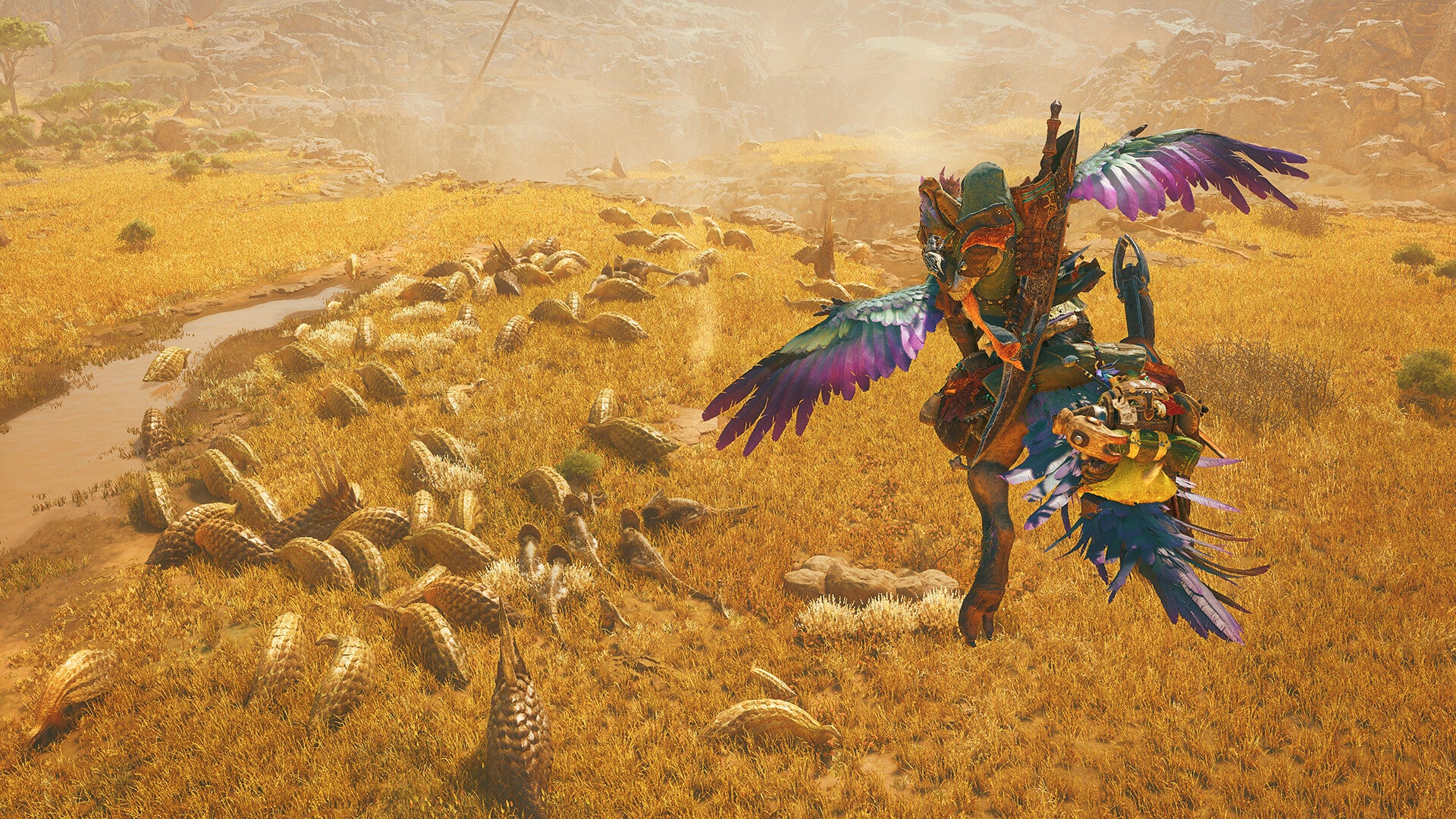
The Three Phases of the Wilds
Each locale, from the Windward Plains to the Scarlet Forest, oscillates between three distinct states:
-
Plenty: A period of abundance where small monsters are calm, resources are plentiful, and the scenery is lush.
-
Inclemency: A brutal environmental shift. In the Windward Plains, this manifests as a massive sandstorm with frequent lightning strikes (the Sandtide). This is when Apex monsters like Rey Dau emerge.
-
Fallow: The aftermath of the storm, where the land is harsh and resources are scarce, forcing monsters to be more aggressive for survival.
This “world of duality” means you can’t just hunt on your own terms. You must adapt your gear and strategy to the sky above you.
Innovation in the Hunt: Seikrets and Weapon Swapping
For the first time in series history, hunters are no longer limited to a single weapon per expedition. Your new companion, the Seikret, is more than just a mount; it is a mobile armory.
The Power of Two
While riding your Seikret, you can swap between a primary and secondary weapon. This opens up unprecedented tactical flexibility:
-
The Hybrid Approach: Use a Heavy Bowgun to soften up a flying monster from a distance, then swap to Dual Blades for high-mobility melee once it’s grounded.
-
The Elemental Strategy: Carry a Fire-element weapon for the initial encounter, then switch to a secondary weapon better suited for a monster’s second phase or a sudden intruder.
Your Seikret also handles the “busy work.” It can auto-navigate to your target while you sharpen your blade, consume a meal, or craft items on the move, ensuring the momentum of the hunt never stops.
Mastering Focus Mode and Focus Strikes
Combat in Monster Hunter Wilds introduces Focus Mode, a mechanic that adds a layer of precision previously unseen in the series. By entering Focus Mode, your hunter gains a directional guard and the ability to target specific parts of a monster with pinpoint accuracy.
Exploiting Wounds
As you attack a monster, you will notice Wounds forming on its hide. These aren’t just visual—they are temporary weak points.
-
Focus Strikes: Once a wound is opened, you can unleash a “Focus Strike”—a powerful, unique animation tailored to your weapon that deals massive damage and destroys the wound for extra rewards.
-
The Clash: Certain heavy weapons can now enter a Clash with a monster. This is a cinematic test of strength where correctly timed inputs can result in a massive knockdown, giving your team a huge opening.
-
Optimization and PC Performance in 2026
At launch, Monster Hunter Wilds was notorious for its heavy hardware demands. However, as of the March 2026 Update (Ver 1.041), Capcom has significantly optimized the RE Engine for PC players.
With the inclusion of DLSS 4/FSR 4 and improvements to VRAM management, the game now runs much smoother on mid-range hardware. For the best experience, an RTX 4060 or RX 6700XT is recommended to maintain 60 FPS at 1080p. The addition of a “Foliage Density” setting has also been a godsend for players looking to boost frames in the dense Scarlet Forest.
Conclusion: A New Era for Hunters
Monster Hunter Wilds is a bold step forward. By blending the cinematic immersion of World with the mechanical fluidity of Rise, Capcom has created the definitive hunting experience. The seamless transition between the village and the field makes the world feel truly “wild,” while the Seikret and Focus Mode provide tools that make every hunt feel fresh.